Question 1
"Almost everyone believes that the universe itself, had a beginning at the Big Bang."
"With the proof now in place, cosmologists can no longer hide behind the possibility of a past-eternal universe. There is no escape, they have to face the problem of a cosmic beginning."
Question 2
The Big Bang is the event that created the universe as we know it. Stephan Hawking theorized that the Big Bang arose from a singularity the size of a quantum particle.
So how did the quantum sized particle come into being? Hawking believed the Quantum Mechanics (specifically Heisenberg's Uncertainty Principle) allowed the singularity to pop into existence.
1 - No One Created Something Out Of Nothing (Atheistic View)
2 - Someone Created Something Out Of Nothing (Theistic View)
Which is more reasonable?
The Law of Causality
Analogy
What does this mean?
However
We need more than just speculation using logic. We need evidence.
Apologist Frank Turek has a simple acronym for the evidence of how the universe was formed.
S- Second law of thermodynamics which state that the universe is running down.
If the universe is running down, something must have wound it up. We would have no energy left if the universe was eternal in the past (You can't have a finite amount of energy from the wound up universe is the there was an infinite of run down time - Like how you can't drive an infinite amount of miles on a single tank of gas as eventually you will run out of gas)
U - Universe is expanding infinitely so it must have had a starting point. Hubble discovered this in 1929.
Everything came from a single point, a point of infinite density, called the singularity (Remember Stephan Hawking theorizes everything started from a quantum singularity)
R - Radiation echo is the remnant heat from the Big Bang, discovered by Arno Penzias and Robert Wilson in 1965.
This is a great piece of evidence for the Big Bang.
G - Great galaxy seeds, the very fine temperature variations required in the afterglow of the Big Bang, to form galaxies.
E - Einstein's theory of Relativity (The universe came into existence with both space and time)
Summary - There is a lot of evidence to support the universe starting with the Big Bang.
Random vs Design
"If the expansion rate of the universe was different by one part in a thousand, million, million a second after the Big Bang, then the universe would have collapsed back on itself or never developed galaxies."
If the gravitational force were altered more than 1 part in 10^40 (1 with 40 zeros after it - aka an extremely small amount) stars would not exist and therefore neither would we.
Imagine a tape measure that is as wide as the entire known universe and mark it somewhere along the tape.
If you moved that mark by a single inch, that is how little the gravitational force would need to be off for life to not exist. (According to outspoken Atheist and Cosmologist, Dr. Stephan Hawking)
The incredibly tight tolerances that the universe needed to exist would suggest design over random chance.
However, there is another argument that might favor chance over design.
The Case For Randomness
In the Multiverse theory there are an infinite number of universes just like ours.
Each universe has a slightly different amount of things like gravity, energy, and other things that require the strict tolerances to exist.
With the multiverse theory, some universes have what is needed to support life and others don't.
There is no design needed because it is all random chance. (If you are asked to guess a number 1-10 to win a prize and you guess every single number between 1 and 10, you are able to win just because you covered every option)
The multiverse theory seems to have come about AFTER the fine tuning argument.
Atheist Christopher Hitchens has even admitted that there isn't really a solid argument against the Fine Tuning argument.
While a multiverse could explain away Intelligent Design, it doesn't have much evidence to support it.
The Case For Design
All nature is going in a direction.
An acorn will always become an oak tree. It can never become a pine tree, an elm tree or a sea horse.
The acorn is not itself a sentient being and does not try to become one thing or another. It's genetics were programmed for an oak tree.
So who did the programming?
Aristotle called this concept "The Unmoved Mover"
If you come out to the kitchen and find a box of alphabet cereal spilled on the table with the words "Take out the trash" spelled out, is it more likely that they spilled randomly and aligned themselves to spell out the words or is it more likely that someone arranged those letters to send you a message?
It is astronomically more likely that someone used those letters to spell a message out for you.
With the Multiverse Theory, those letters could be spilled out in an infinite number of combinations, including "Take out the trash" , which is the main reason atheists point to it as an argument.
But again, there isn't much for evidence for it.
With the current evidence we have, Design seems to be much more likely than Random Chance but with the Multiverse Theory , it's not completely ruled out.
Non-Physical Evidence
If even one thing is morally wrong (i.e. it is wrong to murder) there has to be a higher authority (God).
As humans with equal authority, if we say something is wrong, who is to say it is not right?
"(As an atheist) my argument against God was that the universe seemed so cruel and unjust. But how had I got this idea of just and unjust? A man does not call a line crooked unless he has some idea of a straight line. What was I comparing this universe with when I called it unjust?"
If there isn't a higher standard of morality, then everything subjective (i.e. murder is wrong for you but not for someone else)
If morality comes from humans, why is it an absolute and universal issue to murder someone? Murder cannot be absolutely wrong, but rather just an opinion if it's a made up rule that the majority agrees upon.
If a compass doesn't point to magnetic north but moves consistently, how useful is that compass?
We don't determine right and wrong, we discover it. (As kids we know it is unjust for someone to take our toy. That is without having a philosophy degree)
There has to be a higher power to determines right and wrong.
Question 3
This is a self defeating statement. Truth has to exist for the statement "there is no truth to be true".
- That's a relative truth because again, absolute truth must exist for that statement to be truth.
Your truth - You can fly.
However if you try to jump off of a roof, you will find the Absolute truth that gravity exists and you fall to the ground and break some bones.
Regardless of what you feel is true, that doesn't change what is absolutely true.
If Christianity turns out to be true, would you become a Christian ? -
If your answer is "no" then the truth isn't the issue.
If something is proven to be true and you refuse to believe it , it doesn't change that
it's true.
Question 4
Evil exists because free will exists.
Imagine you had a robot that looked, talked , felt and acted exactly like your ideal mate. However you programmed them to love you.
Is that truly love?
Would you be happy with this "love"?
No, you probably wouldn't because you programmed them to love you. There was no free will.
Pretend you have a partner. You have been in this relationship of years and you are deeply in love. They love you and you love them and you are soulmates.
One day your friends ask you if you want to go to the bar after work. You normally don't do this kind of thing as you prefer to spend all your time with your soulmate. However they say you can go and have fun.
The next night your friends ask you to the bar again and this time you find it easier to go and you come home a little later. This continues for a while until one day you bring someone home from the bar.
Their name is Cinnamon or Sin for short. You and your friends got bored at normal bars and wanted to switch things up.
More and more Cinnamon comes over and you spend time with them instead of your soul mate. Naturally, this strains your relationship but you still try to make it work work anyways.
This is what sin is. It is not so much pure evil and darkness but instead separation from your Soulmate (God).
God allows this evil to exist because love is only love if you choose the person you love.
It takes way more mental gymnastics with theories that we don't have answers for or evidence supporting to explain the beginning of the universe.
Both the universe being created by nothing from nothing and the universe being created by a higher being from nothing are highly miraculous.
But making the single concession that there might be a being out there that we do not understand makes for a much more compelling argument for the creation of the universe than trying to explain away a creator being with a lot of highly random coincidences that we don't have evidence for to try to explain the beginning of the universe.
Occam's Razor highly favors a creator being as you only need 1 missing puzzle piece to make everything fall into place.
Maybe it is like we are ants living in an ant farm. We are unaware that we occupy an inconsequential space on a kid's bedroom shelf.
We have no understanding that there is a being that controls our existence and cannot fathom where they came from.
If use the simplest explanation (Occam's Razor) with the most evidence to support it (SURGE).
If we account for concepts like the Unmoved Mover (something programmed nature)
If we look at where morality comes from (a higher power is the only way to have morality that isn't just someone else's opinion)
A Creator / God being is the most logical conclusion.
Atheist Lee Strobel (an investigative journalist) adamantly tried to disprove the existence of God. Then he ended up writing a book called "The Case for Christ".
I Don't Have Enough Faith to be an Atheist - Frank Turek
Cold Case Christianity - J. Warner Wallace
Judaism
Hinduism
Islam
Christianity
Mormonism
Jehova's Whitness
Druze
Bhuddism
Sihkism
Jainism
Taoism
Dead Sea Scrolls (1947–1956)
Ancient Jewish manuscripts dating from roughly 250 BC to AD 70 that contain portions of nearly every Old Testament book, demonstrating the remarkable preservation of biblical texts over centuries.
Tel Dan Stele
A ninth-century BC Aramaic inscription that contains the phrase "House of David," providing the earliest known archaeological reference to King David outside the Bible.
Mesha Stele (Moabite Stone)
A ninth-century BC inscription by King Mesha of Moab that mentions Israel and describes conflicts similar to those recorded in 2 Kings 3.
Pilate Stone
A first-century inscription discovered at Caesarea Maritima that explicitly names Pontius Pilate, confirming the historical existence of the Roman governor who presided over Jesus' trial.
Hezekiah's Tunnel and Siloam Inscription
An engineering project described in 2 Kings 20 and 2 Chronicles 32, with the surviving tunnel and inscription providing physical evidence of King Hezekiah's preparations for an Assyrian siege.
Taylor Prism (Sennacherib Prism)
An Assyrian record describing King Sennacherib's campaign against Judah and the siege of Jerusalem, closely matching the events described in 2 Kings 18–19.
Cyrus Cylinder
A Persian inscription that reflects King Cyrus's policy of allowing displaced peoples to return to their homelands, consistent with the biblical account of the Jewish return from exile in Ezra.
Pool of Bethesda
Excavations in Jerusalem uncovered a pool complex matching the description in John 5, supporting the Gospel's geographical accuracy.
Pool of Siloam
Archaeologists uncovered a first-century pool consistent with the location where Jesus healed a blind man in John 9, confirming the existence of the site during the New Testament period.
Ketef Hinnom Silver Scrolls
Tiny silver amulets dating to the seventh century BC containing a version of the priestly blessing found in Numbers 6:24–26, representing some of the oldest known biblical text ever discovered.
Honorable Mentions:
The Black Obelisk of Shalmaneser III (depicting King Jehu or his emissary).
The Caiaphas Ossuary (possibly the burial box of the high priest involved in Jesus' trial).
Lachish Reliefs and Lachish Letters (related to Assyrian and Babylonian invasions of Judah).
The House of God Ostracon and other inscriptions mentioning Yahweh.
It's important to note that archaeology rarely "proves" religious claims. Instead, these discoveries are valued because they corroborate the existence of biblical people, places, kingdoms, events, or the transmission of biblical texts, strengthening the Bible's historical context.
One of the strongest arguments often made for the textual reliability of the Bible is the sheer number of surviving manuscripts compared to other ancient works.
It's important to distinguish between textual reliability (whether we know what the original text said) and historical accuracy (whether the events happened). A large number of manuscripts primarily helps with the former. The archeological evidence we covered earlier helps with the latter.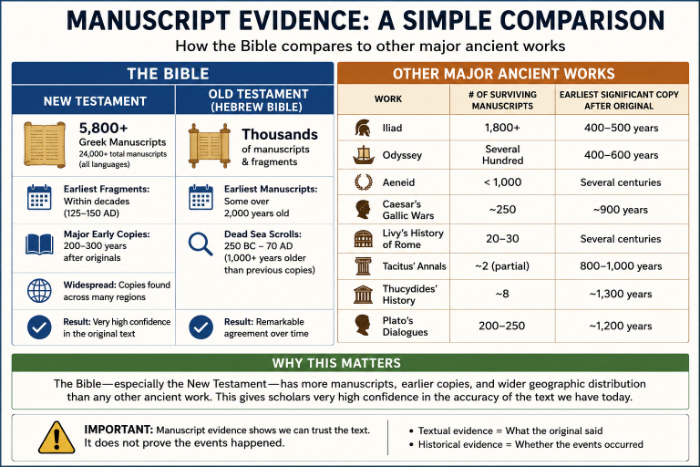
Old Testament (Hebrew Bible)Thousands of manuscripts and fragments, including the Dead Sea ScrollsSome manuscripts over 2,000 years old
Homer's IliadAbout 1,800+ manuscripts and fragmentsRoughly 400–500 years after composition
Homer's OdysseySeveral hundred manuscriptsHundreds of years after composition
Virgil's AeneidFewer than 1,000 manuscriptsSeveral centuries after composition
Caesar's Gallic WarsAbout 250 manuscriptsAbout 900 years after composition
Livy's History of RomeAbout 20–30 substantial manuscriptsSeveral centuries after composition
New Testament Manuscript Evidence
Earliest Fragments
The famous Rylands Papyrus P52 contains a portion of John's Gospel and is commonly dated to around AD 125–150, potentially within a few decades of the original Gospel's writing.
If the Bible is true, Christianity is very likely true.
There is currently no widely accepted archaeological evidence that directly confirms the specific people, cities, kingdoms, or events described in the Book of Mormon.
This is one of the major differences between the Bible and the Book of Mormon from an archaeological perspective.
What archaeologists have found
For the Bible, archaeologists have uncovered numerous inscriptions and artifacts mentioning people such as David, Hezekiah, Pontius Pilate, Caiaphas, and others, as well as cities and events described in biblical texts.
For the Book of Mormon, no artifact, inscription, monument, or ancient document has yet been discovered that is broadly accepted by mainstream archaeologists as referring to:
Nephi
Lehi
Mormon
Moroni
King Benjamin
If we look into the history of Joseph Smith (the founder of Mormonism) we find he was a well known "weaver of tales".
Also - LDS claim to be a "Christian" religion but have expanded the doctrine to 4 books (the Holy Bible, Book of Mormon, Doctrine and Covenants, and Peal of Great Price) when the Holy Bible very clearly states
" I warn everyone who hears the words of the prophecy of this scroll: If anyone adds anything to them, God will add to that person the plagues described in this scroll. 19 And if anyone takes words away from this scroll of prophecy, God will take away from that person any share in the tree of life and in the Holy City, which are described in this scroll."
Translation - The Bible, warns against listening to anyone who adds to the Scripture or Subtracts from it. So how can one believe in the LDS doctrine when one of the books they claim as part of their doctrine says to not add the other books they have as part of their doctrine.
If we look at the large amount of just Archeological evidence for the God of the Bible (and compare that to the lack of evidence like LDS has) it is very likely that the God of the Bible is the creator of the universe.
The Bible has many more surviving original manuscripts than all of the other Classical Literary Works we do not question the accuracy of.
While the manuscript evidence doesn't prove the events of the Bible happened (the archeological evidence does that) it does show the Bible we have today is the same as the original Bible.
We have covered secular evidence for Christianity but that doesn't mean there isn't evidence for other religions.